

Arizona Commercial Roofing: Foam, Single-Ply, and Tile in a 110-Degree Climate
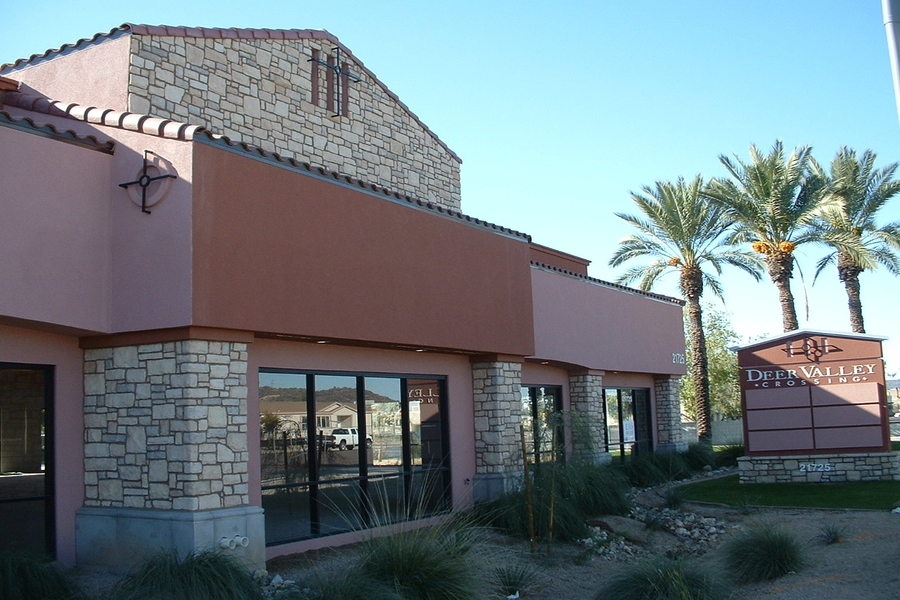
On an Arizona commercial building, the roof is the hottest surface on the property and the largest single lever on the cooling bill. A dark low-slope roof under a July sun runs far above air temperature; a bright, highly reflective one runs dramatically cooler under identical conditions. That difference shows up on the utility bill every month for the life of the building.
Reflectivity is the first specification decision. Everything after it is about who maintains what, and when.
Spray polyurethane foam (SPF)
SPF is sprayed as a liquid that expands into a seamless, self-flashing, fully-adhered insulating layer, then protected with an elastomeric coating.
Why it suits Arizona. It is monolithic — no seams, no fasteners, no laps, which removes the places low-slope roofs usually leak. It self-flashes around every curb, pipe, and penetration, and on a busy mechanical roof that is a genuine advantage. It adds insulation and reflectivity in one operation. It can be sprayed over an existing roof to build positive slope and correct ponding without a tear-off.
The obligation. The foam itself has no UV resistance whatsoever. The coating is the entire protection system, and it is consumable. Plan on inspection and recoating on a cycle — commonly in the ten-to-twenty-year range depending on the coating, the mil thickness applied, and the traffic. Skip the recoat and the sun destroys the foam. Owners who treat SPF as maintenance-free are the ones who end up replacing it early.
Single-ply membranes (TPO, PVC)
Sheet membranes mechanically fastened, adhered, or ballasted, with heat-welded seams.
Why it suits Arizona. White membrane delivers high reflectivity out of the box. Installation is fast and the cost is predictable. Manufacturer warranties are long and well understood by lenders.
The trade-offs. Every seam and fastener is a detail that must be executed correctly. Heat and UV are hard on any polymer over decades, so thickness matters more here than in a mild climate — thin membranes age faster in this sun. Reflectivity also degrades as dust accumulates, which is a real effect in the valley; a roof nobody ever washes does not keep its rated reflectance.
Concrete tile
Predominantly residential and light commercial, on sloped roofs.
Why it suits Arizona. Concrete tile is essentially immune to UV. Installed over battens, it creates a ventilated air space that carries heat away before it reaches the deck — the tile is a rain screen and a sun screen, not the waterproofing. Service life is measured in generations.
What people get wrong. The tile is not the waterproof layer. The underlayment is, and the underlayment is what fails. It is the shorter-lived component under the longer-lived one, which makes for an awkward and expensive mid-life repair. Specify a high-temperature underlayment and understand that the roof's real service interval is the underlayment's, not the tile's. Tile is also heavy, and the structure has to carry it.
Details that matter more here than elsewhere
Drainage sized for the monsoon. Annual rainfall is low and misleading. The storm intensity is what governs. Primary drainage plus overflow scuppers, correctly sized and placed, is not optional — a blocked primary drain on a parapeted roof is a structural load problem, not just a leak.
Positive slope, always. Ponded water on a hot roof accelerates coating breakdown and finds every weakness. Where an existing roof ponds, SPF is often the most economical way to build slope without a tear-off.
Parapets and coping. Wind-driven rain gets behind coping caps. Continuous cleats, sealed joints, and a real counterflashing detail earn their cost in the first monsoon.
Mechanical curbs. Rooftop units, their curbs, and their service traffic concentrate wear. Walk pads and a service plan protect the field of the roof.
The short version
- Busy mechanical roof, existing building, ponding to correct — SPF, with the recoat cycle written into the owner's maintenance plan from day one.
- New low-slope commercial, clean layout, predictable budget — white single-ply, specified thick, with a washing interval.
- Sloped residential or light commercial, long hold — concrete tile over battens, with a high-temperature underlayment.
The roof interacts with everything above it in Arizona construction materials, and with how you insulate below it in insulation assemblies for Arizona buildings.
Re-roofing or specifying new? Send us a note and we will match the assembly to how long you intend to hold the building.