

CMU Block Construction in Arizona: Why Masonry Still Wins in the Desert
Concrete masonry keeps winning in Arizona for a reason that has nothing to do with tradition: thermal mass works here. In a climate where the temperature swings twenty-five to thirty-five degrees between afternoon and pre-dawn, a heavy wall does something a light wall cannot.
Thermal mass, explained without the physics lecture
A CMU wall does not resist heat the way insulation does. It absorbs heat, slowly, and gives it back later. In a climate with a flat temperature profile that is useless — the wall just saturates. But in the Sonoran Desert the night reliably dumps the stored heat back out.
The practical effect is time-shifting and flattening. The peak load reaching the interior arrives hours after the actual solar peak, and it arrives lower. For a building on a daytime schedule — an office, a school, a warehouse — that means the mechanical system never sees the spike it would otherwise be sized for.
That is why masonry has never gone away in Arizona while it has faded in climates where it never paid for itself.
The advantages people forget to price
Termites do not eat it. Subterranean termites are a genuine, ongoing Arizona problem. A masonry structure removes the food source from the structural system entirely. Over a thirty-year hold, the avoided treatment and repair is real money.
Fire resistance is inherent. You do not assemble a rated wall out of layers; the wall is the rating. On mixed-use, multifamily, and property-line conditions, that frequently simplifies the whole design.
Sound. Mass blocks sound. Along an arterial, next to a freeway, or between tenant suites, an eight-inch grouted wall does what a stud wall needs an expensive assembly to approximate.
Maintenance approaches zero. There is no siding to replace, nothing to rot, and integrally colored or ground-face block never needs repainting. For owners holding an asset long-term, that line matters more than first cost.
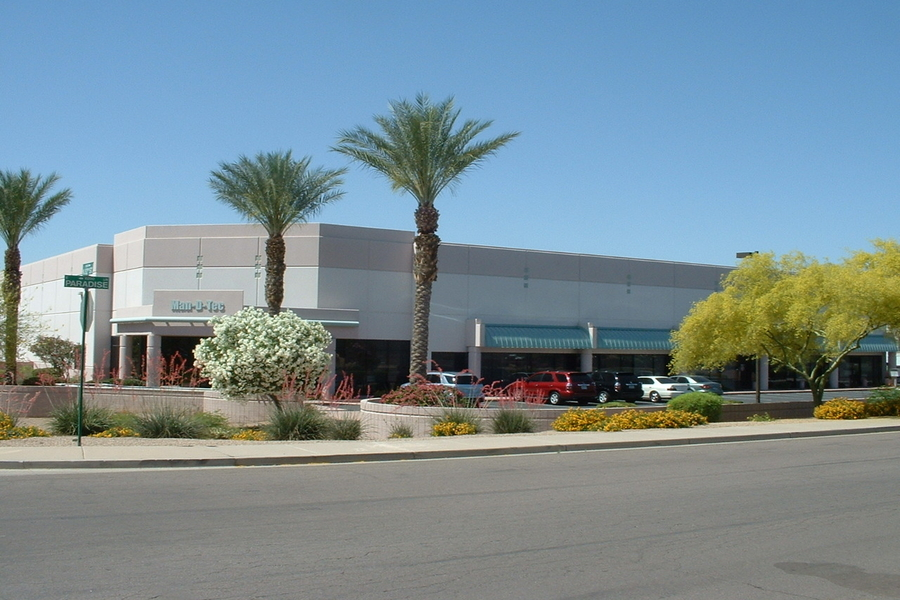
Structure and enclosure at once. A reinforced, grouted CMU wall is the shear system and the enclosure in one trade. On single-story commercial and industrial buildings that consolidation is often the reason masonry comes in competitive on bid day — see Man-D-Tec and Wright.
The honest disadvantages
Mass is not insulation. This is the mistake that gets made most. Thermal mass and R-value are different properties, and the energy code cares about both. Getting a masonry wall to perform means insulating it — usually with rigid insulation in the cavity of a cavity wall, or continuous insulation outboard, or insulated inserts in the cells. Bare block is a poor performer on paper and in practice.
Speed and labor. Masonry is slower than panelized framing and depends on skilled crews. On a compressed schedule that is a genuine constraint.
Penetrations are permanent. Coring block after the fact is expensive. Late MEP coordination hurts far more on a masonry job than on a framed one — the drawings have to be right earlier.
Cracking follows movement. Control joints have to be placed and detailed deliberately, and they need to be part of the elevation composition rather than an afterthought the mason locates in the field.
Where we specify it
Single-story commercial, industrial, and institutional buildings are the natural fit — the loads are modest, the spans are regular, and the wall is doing three jobs at once. Property-line and fire-separation conditions push us there as well. So does any project where the owner intends to hold the building rather than flip it.
We move away from masonry when the schedule is genuinely compressed, when the structure needs long clear spans that want steel, or when the design calls for a lightweight, articulated skin better served by stucco or EIFS over framing.
For how the wall decision fits the rest of the envelope, start with Arizona construction materials.
Considering masonry for a valley project? Send us a note — we will tell you honestly whether it pencils for your building type and schedule.